
No Law Gives Right To Husband To Beat & Torture His Wife: De
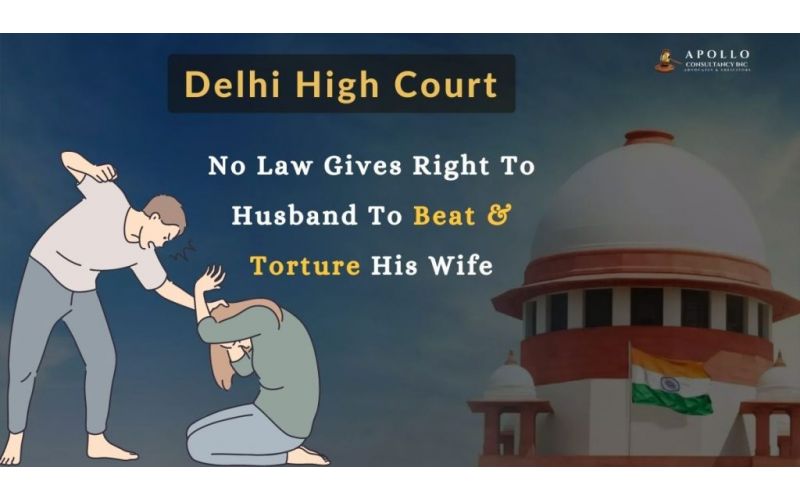
No Law Gives Right To Husband To Beat & Torture His Wife: Delhi High Court Grants Divorce To Woman On Ground Of Cruelty And Desertion
|
Synopsis
The court was hearing an appeal by a woman challenging the decision of the trial court, whereby it has dismissed her petition seeking divorce from the man on the ground of cruelty and desertion
While granting divorce to a woman on the grounds of cruelty and desertion by a man, the Delhi High Court held “No law gives the right to a husband to beat and torture his wife”.
The division bench of Justice Suresh Kumar Kait and Justice Neena Bansal Krishna said, in this case, it has been proved that the man failed to resume companionship with his wife and not only did there exist physical separation but it was also coupled with “animus” of not bringing her back to the matrimonial home.
Taking into account the medical documents of the woman, the court said in the absence of any rebuttal by the man, it has to be held that the woman’s testimony of being subjected to physical assault stands corroborated by the medical documents.
“Merely because the parties got married and the respondent was her husband, no law gave him the right to subject his wife to beatings and torture. Such conduct of the respondent necessarily qualifies as physical cruelty entitling the appellant to divorce under Section 13(1) (ia) of Hindu Marriage Act, 1955”, the bench said.
The court was hearing an appeal by a woman challenging the decision of the trial court, whereby it has dismissed her petition seeking divorce from the man on the ground of cruelty and desertion.
The appellant woman said that soon after the marriage she was subjected to physical and mental torture and various atrocities were meted out to her which she continued to tolerate in the fond hope that with passage of time “things would get settled”. However, the atrocities of the man and his family members increased day by day since their sole aim was to get rid of the her so that they could marry him to some other girl of some affluent family.
The woman also said that there was repeated demand for dowry and that she was deserted by the man who refused to take her back to the matrimonial home.
The bench noted that the woman had deposed that she was left at her parental home on May 11, 2013 in an injured condition and thereafter despite her efforts, the man failed to take her back to the matrimonial home.
It also noted that the man has not countered the testimony of the woman that she was brought back to the matrimonial home, for which there existed no reason.
“That the respondent had no intention of resuming the matrimonial relationship which also got reflected when he chose not to contest the petition”, the court said.
The bench noted that the divorce petition was filed after more than two years of separation and therefore the appellant is also entitled to divorce on the ground of desertion under Section 13 1 (ib) of the HMA.
Furthermore, the court noted that the man, who was present before it at the time of passing the order has no objection to the grant of divorce. “We accordingly find merit in the appeal and the marriage between the appellant and the respondent is hereby dissolved. The appeal is allowed and all the pending applications are hereby disposed of, accordingly”, the court ordered.
Post Categories
Featured Posts








Latest Posts








Latest Posts

Protecting Confidentiality: A Legal Guide to Non-Disclosure Agreements (NDAs) in India
In a rapidly growing business ecosystem, safeguarding sensitive information is paramount. For Indian businesses, Non-Disclosure Agreements (NDAs) have become crucial legal tools to protect trade secrets, proprietary information, client details, and more. This article explores NDAs from an Indian legal ...
ED Summons Under PMLA: What to Do and What Not to Do (Complete Legal Guide)
Receiving a summons from the Enforcement Directorate (ED) under the Prevention of Money Laundering Act, 2002 (PMLA) can be intimidating. For many individuals—business owners, directors, promoters, professionals, or even family members—an ED summons creates panic, confusion, and fear of arrest. ...

DBS Bank Directors Can’t Be Prosecuted For Acts Of Lakshmi Vilas Bank Before Amalgamation : Supreme Court Quashes Criminal Case
The Supreme Court today ruled that DBS Bank and its directors, who were appointed after the amalgamation with Lakshmi Vilas Bank(LVB) and had their appointments approved by the Reserve Bank of India (RBI), cannot be held criminally liable for actions ...

Indian Penal Code
The Indian Penal Code (IPC) is the official criminal code of India. It is a comprehensive code intended to cover all substantive aspects of criminal law. The code was drafted on the recommendations of the first law commission of India ...

Parliament Passes Forest (Conservation) Amendment Bill, 2023
After opposition walked out over their demands for discussion on Manipur Violence, the Rajya Sabha passed the contentious Forest (Conservation) Amendment Bill, 2023 today. It aims to amend certain provisions under the Forest (Conservation) Act, 1980, to extend and exempt ...

Anti-Money Laundering (AML) Compliance: Best Practices for Law Firms
In today's globalized economy, money laundering poses a significant threat to financial systems and institutions, including law firms. As facilitators of various financial transactions, law firms are often targeted by money launderers seeking to legitimize illicit funds. Anti-Money Laundering (AML) ...

Speak With Our
Get a Appointment