
Freezing of Bank Accounts by ED/GST/Police – Legal Remedie
Freezing of Bank Accounts by ED/GST/Police – Legal Remedies Explained
|
Has your bank account suddenly been frozen by the Enforcement Directorate, GST authorities, or police investigation?
For businesses and individuals alike, a frozen bank account can bring operations to an immediate halt.
Why Bank Accounts Are Frozen by Authorities
Authorities in India have statutory powers to freeze or provisionally attach bank accounts during investigations involving:
-
Money laundering
-
Tax evasion
-
GST fraud
-
Financial crimes
-
Economic offences
While these powers exist to prevent misuse of funds during investigation, account freezing often causes severe hardship for businesses and individuals, particularly when done without adequate justification.
Legal Provisions Used to Freeze Bank Accounts
Different authorities rely on different laws to freeze accounts.
1. Enforcement Directorate (ED)
Under the Prevention of Money Laundering Act (PMLA), ED can attach or freeze assets suspected to be proceeds of crime.
Key powers arise under:
-
Section 5 – Provisional attachment of property
-
Section 17 – Search and seizure
ED may direct banks to freeze accounts during investigation.
GST Authorities
Under the Central Goods and Services Tax Act, 2017, bank accounts may be attached through:
Section 83 – Provisional Attachment
This provision allows authorities to freeze accounts if they believe it is necessary to protect government revenue during investigation or assessment proceedings.
1. Enforcement Directorate (ED)
Under the Prevention of Money Laundering Act (PMLA), ED can attach or freeze assets suspected to be proceeds of crime.
Key powers arise under:
-
Section 5 – Provisional attachment of property
-
Section 17 – Search and seizure
ED may direct banks to freeze accounts during investigation.
2. GST Authorities
Under the Central Goods and Services Tax Act, 2017, bank accounts may be attached through:
Section 83 – Provisional Attachment
This provision allows authorities to freeze accounts if they believe it is necessary to protect government revenue during investigation or assessment proceedings.
3. Police Authorities
Police may freeze bank accounts under:
Section 102 of the Criminal Procedure Code (CrPC)
This allows police to seize property (including bank accounts) linked to alleged offences.
However, such action must be reported to the Magistrate.
Practical Problems Faced by Businesses
In practice, freezing of accounts often results in:
-
Inability to pay salaries
-
Disruption of daily business operations
-
Loan defaults
-
Contractual breaches
-
Severe reputational damage
Courts have repeatedly observed that indiscriminate freezing of accounts can violate fundamental rights and business continuity.
Judicial View on Freezing of Bank Accounts
Indian courts have emphasized that powers to freeze bank accounts must be used cautiously.
Courts have held that:
-
Authorities must record valid reasons
-
Action should be proportionate
-
Business operations should not be unnecessarily paralysed
Several High Courts have intervened where authorities acted arbitrarily or without proper jurisdiction.
How to Unfreeze a Bank Account – Legal Remedies
If your bank account has been frozen, the following remedies are generally available.
1️⃣ Representation to the Concerned Authority
The first step is usually filing a formal representation to the authority that issued the freeze order.
This may include:
-
Explanation of transactions
-
Financial records
-
Compliance documents
Sometimes authorities may partially lift restrictions or allow operational usage.
2️⃣ Filing an Application Before the Appropriate Tribunal
Depending on the authority involved:
-
PMLA matters → Adjudicating Authority / Appellate Tribunal
-
GST matters → GST Appellate Authority
-
Criminal cases → Magistrate Court
These forums may review the legality of attachment.
3️⃣ Approaching the High Court Under Writ Jurisdiction
In many cases, the most effective remedy is filing a writ petition before the High Court.
High Courts have broad powers under Article 226 of the Constitution of India.
A writ petition may be filed where:
-
The account freeze is arbitrary
-
No proper order exists
-
Authorities exceed jurisdiction
-
Fundamental rights are violated
-
Business operations are severely affected
High Court Relief for Unfreezing Accounts
High Courts have often granted relief such as:
✔ Immediate de-freezing of bank accounts
✔ Permission for limited withdrawals
✔ Direction to authorities to review orders
✔ Setting aside illegal attachment orders
In urgent cases, courts may even grant interim relief within days to restore business operations.
Practical Steps Businesses Should Take Immediately
If your account is frozen:
✔ Obtain the exact order issued to the bank
✔ Identify the authority and legal provision used
✔ Preserve all financial records and correspondence
✔ Seek professional legal advice immediately
✔ Avoid suspicious transactions that may worsen the investigation
Early legal intervention significantly improves chances of relief.
Key Takeaway
Freezing of bank accounts is a powerful investigative tool, but it must be exercised lawfully and proportionately.
Where authorities act beyond their legal powers or cause disproportionate hardship, courts have consistently protected the rights of businesses and individuals.
Understanding your legal remedies is crucial to restoring financial operations quickly.
Need Immediate Legal Assistance?
If your bank account has been frozen by ED, GST authorities, or police, prompt legal action can make a significant difference.
Connect with us for case-specific legal advice and strategic representation.
Post Categories
Featured Posts







Latest Posts








Latest Posts

Remote Work and Employment Law in India: Navigating Legal Implications for Employers and Employees
Remote Work and Employment Law in India: Navigating Legal Implications for Employers and Employees The rise of remote work, accelerated by the COVID-19 pandemic, has fundamentally changed the way businesses operate and employees engage with their work. While remote work ...

Estate Planning and Succession Laws for NRIs: A Comprehensive Guide
Estate Planning and Succession Laws for NRIs: A Comprehensive Guide Estate planning is not just a necessity; it's a critical step in securing your family’s future, ensuring the seamless transfer of assets, and minimizing legal complications. For Non-Resident Indians (NRIs), ...

Empowering NRIs with Insights into Taxes, Investments, and Banking Regulations
Introduction: The financial landscape for Non-Resident Indians (NRIs) is complex, spanning a myriad of regulations, taxes, and investment opportunities. As global citizens, NRIs navigate diverse economic ecosystems, balancing rights and responsibilities across borders. In this article, we delve into the ...

Supreme Court: BCI Rules For Candidate Seeking Enrolment As Advocate To Have Completed Law Course From Recognized College Are Valid
The Supreme Court Friday held as valid the rules framed by the Bar Council of India requiring candidates seeking enrolment as an advocate to have completed their law course from a college recognized by the top Bar body. A vacation ...
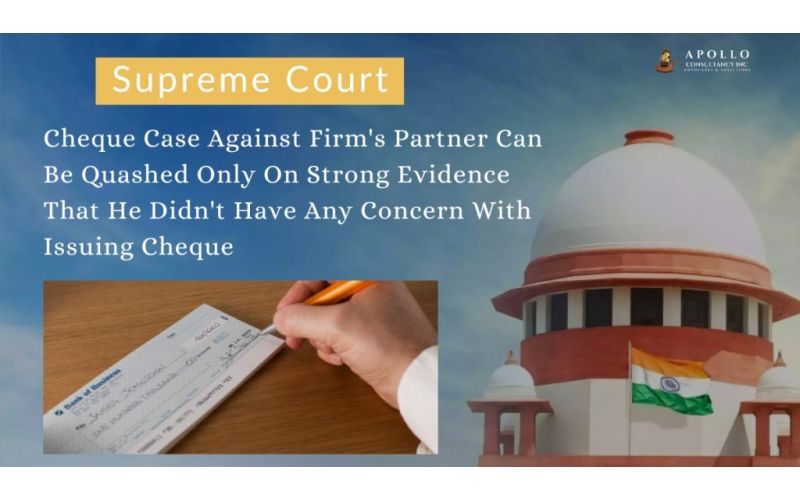
Cheque Case Against Firm’s Partner Can Be Quashed Only On Strong Evidence That He Didn’t Have Any Concern With Issuing Cheque : Supreme Court
The Supreme Court observed that a cheque case against a partner of the firm cannot be quashed under Section 482 CrPC unless there is unimpeachable and incontrovertible evidence that he/she did not have any concern with the issuance of cheques. ...

Supreme Court Refuses To Interfere With HC Order Allowing Delhi University To Use CLAT Score For 5 Yr LLB Admissions In 2023-24
The Supreme Court on Monday(September 25) refused to interfere with the interim order passed by the Delhi High Court allowing the University of Delhi to admit students in the 5 year LL.B course of its Faculty of Law on the ...

Speak With Our
Get a Appointment