
BREAKING | Arbitration Clauses In Unstamped Agreements Enfor
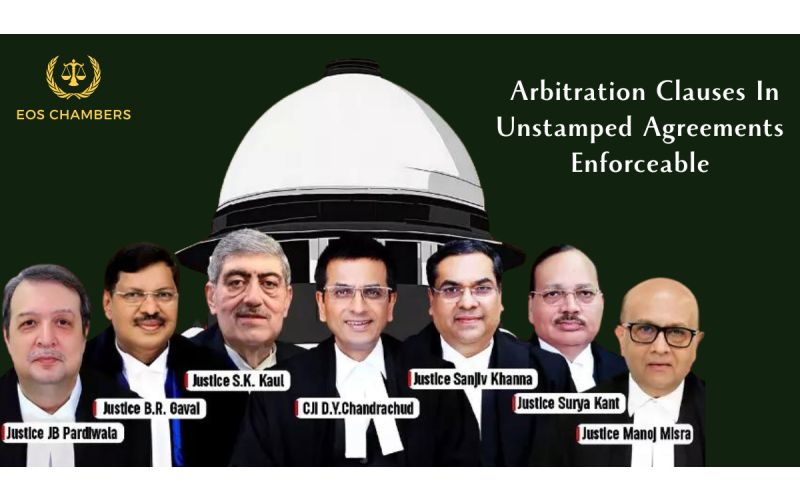
BREAKING | Arbitration Clauses In Unstamped Agreements Enforceable : Supreme Court 7-Judge Bench Overrules 'NN Global' Decision
|
A seven-judge bench of the Supreme Court on Wednesday (December 13) ruled that arbitration clauses in unstamped or inadequately stamped agreements are enforceable. Insufficiency of stamping does not make the agreement void or unenforceable but makes it inadmissible in evidence. However, it is a curable defect as per the Indian Stamp Act, the Court pointed out.
The Court overruled the judgment rendered by a 5-judge bench in April this year in M/s. N.N. Global Mercantile Pvt. Ltd. v. M/s. Indo Unique Flame Ltd. And Ors which had by a 3:2 majority held that unstamped arbitration agreements are not enforceable.
The bench comprising Chief Justice of India DY Chandrachud, Justice Sanjay Kishan Kaul, Justice Sanjiv Khanna, Justice B R Gavai, Justice Surya Kant, Justice JB Pardiwala, and Justice Manoj Misra passed the judgement in the case In Re Interplay Between Arbitration Agreements Under The Arbitration And Conciliation Act 1996 And The Indian Stamp Act 1899.
Conclusions :
CJI DY Chandrachud read out the conclusions of the judgment as follows :
a. Agreements which are not stamped or inadequately stamped are not void ab initio or unenforceable, they are inadmissible in evidence.
b. Non-stamping or inadequate stamping is a curable defect.
c. An objection as to stamping does not fall for determination under Sections 8 or 11 of the Arbitration Act. The concerned court must examine if an arbitration agreement prima facie exists.
d. Any objection in relation to the stamping of the agreement fall within the ambit of the arbitral tribunal.
e. The decision in NN Global 2 and SMS Tea Estates are overruled.
CJI Chandrachud in his judgment pointed out that one of the objectives of the Arbitration and Conciliation Act is to minimise the supervisory role of courts in arbitration contracts. Obligating the Court to decide the issue of stamping under S 8 and 11 will defeat the purpose of the legislation.
Justice Sanjiv Khanna wrote a concurring opinion stating that unstamped agreements are not rendered void or void ab initio.
Background :
The 7-judge bench case arose out of a curative petition filed against its 2020 ruling in Bhaskar Raju and Brothers and Anr V. s Dharmaratnakara Rai Bahadur Arcot Narainswamy Mudaliar Chattram & Other Charities and Ors While hearing the curative plea, a 5-judge bench referred the matter to a 7-judge bench in September this year to revisit the correctness of NN Global.
In 2020, the Supreme Court, in the case Bhaskar Raju and Brothers and Anr V. s Dharmaratnakara Rai Bahadur Arcot Narainswamy Mudaliar Chattram & Other Charities and Ors had observed that an arbitration clause in an agreement which is required to be duly stamped, if not sufficiently stamped, cannot be acted upon by the Court.
In the said case, one of the parties to the agreement filed a petition under Section 11(6) of the Arbitration Act before the High Court of Karnataka. The other party, entered appearance and contended that the lease deed being insufficiently stamped had to be mandatorily impounded under Section 33 of the Karnataka Stamp Act, 1957 and it could not be relied upon unless proper duty and penalty was paid. However, the High Court invoked the power under Section 11(6) of the Act, and appointed an Arbitrator to decide the dispute between the parties.
In appeal, the Apex Court bench comprising of then CJI SA Bobde, Justices BR Gavai and Surya Kant noted that admittedly, both the lease deeds are neither registered nor sufficiently stamped as required under the Karnataka Stamp Act, 1957. The bench had relied upon SMS Tea Estates Private Limited vs. Chandmari Tea Company Private Limited.
In April, a Constitution Bench of the Supreme Court by 3:2 majority had held that arbitration agreement in unstamped contract is unenforceable. On July 18 this year, the 5-judge bench issued notice in the curative petition filed against the 2020 judgment in Bhaskar Raju and Brothers and Anr V. s Dharmaratnakara Rai Bahadur Arcot Narainswamy Mudaliar Chattram & Other Charities and Ors. While hearing the curative petition, the validity of the judgment delivered by a 5-judge bench in the case of M/s. N.N. Global Mercantile Pvt. Ltd. v. M/s. Indo Unique Flame Ltd. And Ors arose for consideration.
In NN Global, a Bench comprising Justice K.M. Joseph, Justice Ajay Rastogi, Justice Aniruddha Bose, Justice Hrishikesh Roy and Justice C.T. Ravikumar had answered the reference on the issue by a 3:2 majority. The majority had decided that an instrument which is not stamped cannot be said to be a contract enforceable in law within the meaning of S. 2(h) of the Contract Act. On September 26, a 5-judge bench had referred the issue to a larger bench to revisit the correctness of NN Global.
Arguments Before The Court
The petitioners argued that existence of an arbitration agreement and validity of the arbitration agreement were two different concepts. Further, under Section 11 of the Arbitration and Conciliation Act, 1996, the power of the court was confined to the examination of the existence of the agreement and not to the validity of the same. Thus, the court only had to determine if an agreement existed. The same, as per the petitioners, could be done by dissecting the nature of correspondence between the parties, including telecommunication, statements, zoom calls etc. However, the validity of the agreement was for the arbitrator to decide upon. Petitioners added that the ambit of Section 16, which deals with the competence of an arbitral tribunal to rule on its jurisdiction, was wide enough to allow the Arbitrator to make considerations with respect to the stamping of the document. They also relied upon the 'doctrine of separability' to argue that even if an agreement was null and void, the arbitration agreement within it would still survive as it was 'separate'.
Post Categories
Featured Posts




Latest Posts







Latest Posts

𝐋𝐞𝐠𝐚𝐥 𝐄𝐭𝐡𝐢𝐜𝐬 & 𝐏𝐫𝐨𝐟𝐞𝐬𝐬𝐢𝐨𝐧𝐚𝐥𝐢𝐬𝐦: 𝐁𝐮𝐢𝐥𝐝𝐢𝐧𝐠 𝐓𝐫𝐮𝐬𝐭 𝐢𝐧 𝐭𝐡𝐞 𝐋𝐞𝐠𝐚𝐥 𝐈𝐧𝐝𝐮𝐬𝐭𝐫𝐲
🔹 𝑰𝒏𝒕𝒆𝒈𝒓𝒊𝒕𝒚. 𝑨𝒄𝒄𝒐𝒖𝒏𝒕𝒂𝒃𝒊𝒍𝒊𝒕𝒚. 𝑪𝒐𝒏𝒇𝒊𝒅𝒆𝒏𝒕𝒊𝒂𝒍𝒊𝒕𝒚. These pillars define a true legal professional. But in today’s fast-paced legal landscape, how do we maintain them? ✔ 𝑼𝒑𝒉𝒐𝒍𝒅𝒊𝒏𝒈 𝑪𝒍𝒊𝒆𝒏𝒕 𝑪𝒐𝒏𝒇𝒊𝒅𝒆𝒏𝒕𝒊𝒂𝒍𝒊𝒕𝒚: A lawyer’s duty is to protect sensitive information—breaching it damages trust. ✔ 𝑨𝒗𝒐𝒊𝒅𝒊𝒏𝒈 ...
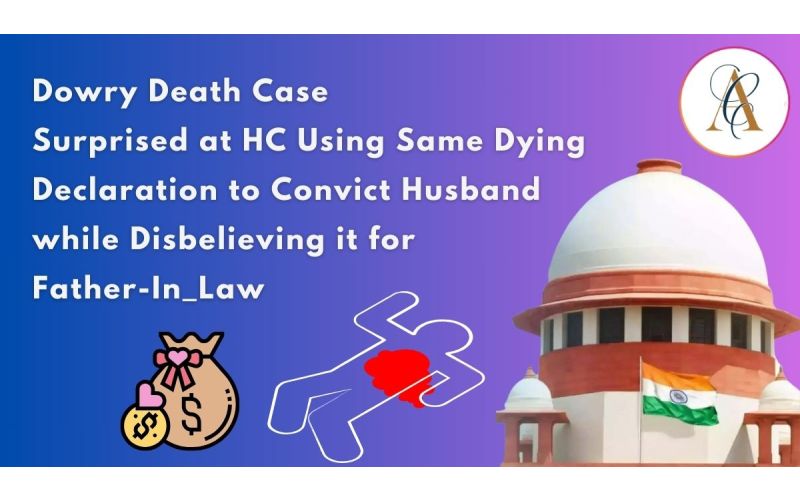
Dowry Death Case | Supreme Court Surprised At HC Using Same Dying Declaration To Convict Husband While Disbelieving It For Father-in-Law
The Supreme Court, while acquitting a convict in a dowry death case, emphasized the critical importance of ensuring that a dying declaration is trustworthy and reliable, and inspires confidence when it is considered the sole basis for a criminal conviction. ...

Navigating the Complexities of Corporate & Commercial Laws: Key Considerations for Businesses
In today's dynamic business landscape, understanding and complying with corporate and commercial laws are paramount for organizations aiming to thrive and expand. From formation and governance to contractual relationships and regulatory compliance, adherence to legal frameworks is essential for maintaining ...
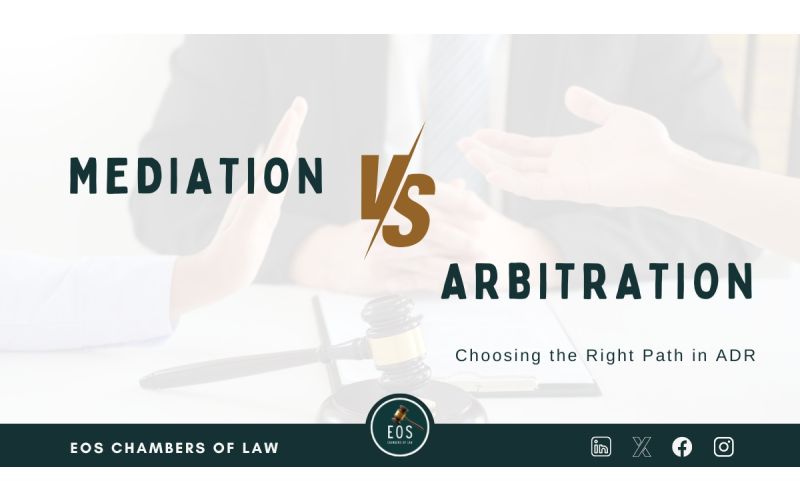
🤝 Mediation vs. Arbitration: Choosing the Right Path in ADR ⚖️
Alternative Dispute Resolution (ADR) has become an increasingly popular method for resolving disputes outside of traditional court litigation. Among the various ADR methods, mediation and arbitration stand out as two of the most commonly used approaches. While both aim to ...
"Why Is CARA Delaying Adoption Process?" Supreme Court Calls For Prompt Action To Benefit Waiting Children & Couples
The Supreme Court on Friday (13.10.2023), raised serious concerns over the delays in the adoption process and the potential impact on both aspiring parents and children in need of loving homes. The remarks came from a bench comprising CJI DY ...

ADR in Workplace Conflicts: A Guide for Employers and Employees
Workplace conflicts are inevitable. Whether stemming from miscommunication, differences in expectations, or interpersonal issues, they can disrupt the professional environment and affect productivity. For both employers and employees, finding a way to resolve these conflicts quickly, fairly, and cost-effectively is ...

Speak With Our
Get a Appointment