
🤝 Mediation vs. Arbitration: Choosing the Right Path in A
🤝 Mediation vs. Arbitration: Choosing the Right Path in ADR ⚖️
|
Alternative Dispute Resolution (ADR) has become an increasingly popular method for resolving disputes outside of traditional court litigation. Among the various ADR methods, mediation and arbitration stand out as two of the most commonly used approaches. While both aim to provide an efficient and less adversarial resolution process, they differ significantly in terms of procedure, outcome, and suitability for different types of disputes.
Mediation: A Collaborative Approach 🤝
Mediation is a voluntary process in which a neutral third party, the mediator, facilitates discussions between the disputing parties to help them reach a mutually agreeable solution. The mediator does not impose a decision but instead assists the parties in exploring their interests and finding common ground. Mediation is particularly well-suited for disputes where the parties wish to maintain or repair their relationship, such as family conflicts, workplace disputes, or commercial negotiations.
Key Benefits of Mediation:
- Control: Parties retain control over the outcome and can tailor the agreement to their specific needs.
- Confidentiality: Mediation proceedings are private, allowing sensitive information to be kept out of the public domain.
- Flexibility: The process is informal and can be scheduled at the convenience of the parties.
Arbitration: A Binding Resolution 📝
Arbitration, on the other hand, is a more formal process where the disputing parties agree to submit their conflict to one or more arbitrators, who act like private judges. The arbitrator(s) review evidence, hear arguments, and render a binding decision, known as an award. Arbitration is often chosen for its finality and enforceability, making it a preferred method in commercial disputes, particularly those involving complex legal issues or large sums of money.
Key Benefits of Arbitration:
- Finality: The arbitrator's decision is usually final and binding, with limited grounds for appeal.
- Expertise: Parties can select arbitrators with specific expertise relevant to the dispute.
- Efficiency: Arbitration can be faster than court litigation, with a streamlined process and limited discovery.
Choosing the Right Path 🛤️
When deciding between mediation and arbitration, parties should consider the nature of their dispute, their relationship with the other party, and their desired outcome. Mediation is ideal for those seeking a collaborative solution and wishing to preserve their relationship, while arbitration is better suited for parties needing a decisive, enforceable resolution with minimal delay.
In conclusion, both mediation and arbitration offer valuable alternatives to traditional litigation, each with its own advantages. By understanding the differences between these ADR methods, parties can make an informed decision that aligns with their goals and the specific circumstances of their dispute.
Post Categories
Featured Posts








Latest Posts








Latest Posts
Repatriation of Funds: Guidelines for NRIs
Navigating the repatriation of funds as a Non-Resident Indian (NRI) can be complex, but understanding the guidelines can simplify the process and ensure compliance with Indian regulations. Here's a comprehensive overview to help NRIs manage their finances effectively. 1️⃣ ...
Supreme Court Grants Extension Till September 30 To Delhi Government For Finalisation Of Scheme : Two Wheeler Aggregators
The Supreme Court on Monday directed the Delhi government to finalise the Delhi Motor Vehicle Aggregator and Delivery Service Provider Scheme, 2023 for regulation of two wheeler aggregators by September 30. The Division Bench of Justice Aniruddha Bose and Justice ...
Grant Of Bail Can't Be Made Dependent On Surrender Of Co-Accused : Supreme Court
A Division Bench of the Supreme Court, while allowing a bail plea, held that the grant of bail to a co-accused person cannot be contingent on the surrender of another accused who is also pertinently the main accused in the ...

Evolving Social and Constitutional Rights for LGBTQ+ Communities
The journey toward equality for LGBTQ+ communities in India has been marked by significant legal and social milestones. From the decriminalization of same-sex relationships to ongoing debates about marriage equality and adoption rights, the evolution of LGBTQ+ rights reflects the ...

Judge Aspirants Get Relief; Supreme Court Sets Aside BPSC's Rejection Of Candidates For Not Producing Original Certificates
The Supreme Court on Friday (September 22) granted relief to three judicial service aspirants from Bihar whose candidatures were rejected by the Bihar Public Service Commission(BPSC) due to non-production of original certificates at the time of interview. Holding that production ...
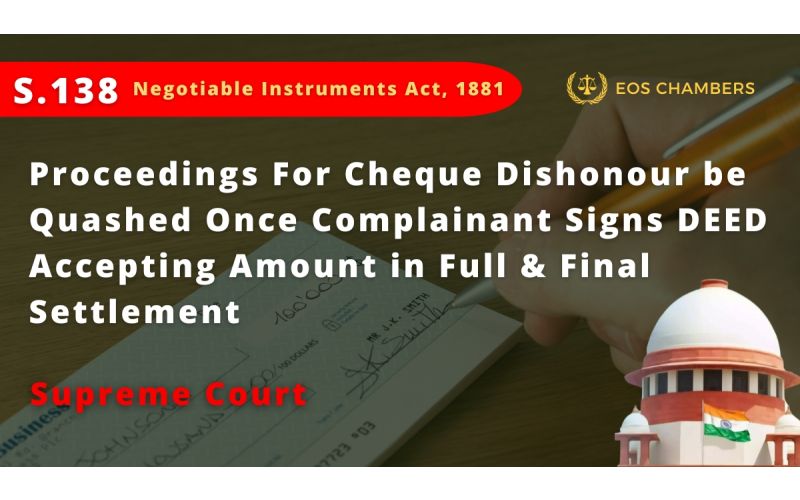
S.138 NI Act | Proceedings For Cheque Dishonour Need To Be Quashed Once Complainant Signs Deed Accepting Amount In Final Settlement : Supreme Court
In a Criminal Appeal arising out of proceedings under Section 138 of the Negotiable Instruments Act, 1881, the Supreme Court has ruled that once the settlement has been arrived at and the complainant has signed the deed, the proceedings under ...

Speak With Our
Get a Appointment