
Cheque Bounce Case Can Be Quashed U/S 482 Only If Amount Is
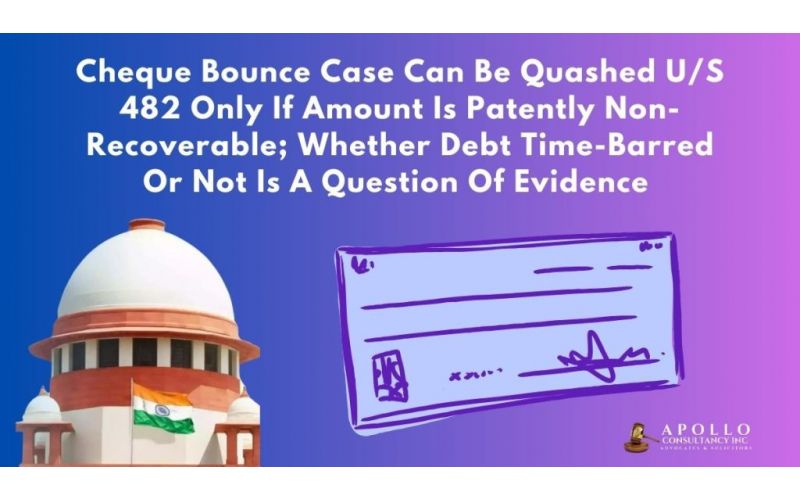
Cheque Bounce Case Can Be Quashed U/S 482 Only If Amount Is Patently Non-Recoverable; Whether Debt Time-Barred Or Not Is A Question Of Evidence : SC
|
The Supreme Court observed that the question whether a cheque was issued towards a time barred debt is to be decided on evidence.
“It is only in cases wherein an amount which is out and out non-recoverable, towards which a cheque is issued, dishonoured and for recovery of which a criminal action is initiated, the question of threshold jurisdiction will arise. In such cases, the Court exercising jurisdiction under Section 482 CrPC will be justified in interfering but not otherwise”, the bench of Justices AS Bopanna and Prashant Kumar Mishra said.
In this case, the Andhra Pradesh High Court quashed a cheque bounce complaint on the ground that the prosecution was not in respect of a legally recoverable debt.
In appeal, the court referred to its earlier judgments (S. Natarajan vs. Sama Dharman & Anr. (2021) 6 SCC 413 and A.V. Murthy vs. B.S Nagabasavanna (2002) 2 SCC 642) that explained the scope of consideration in a petition filed under Section 482 of CrPC seeking quashment of a complaint filed under Section 138 of NI Act.
“It is crystal clear that this Court keeping in perspective the nature of the proceedings arising under the NI Act and also keeping in view that the cheque itself is a promise to pay even if the debt is barred by time has in that circumstance kept in view the provision contained in Section 25(3) of the Contract Act and has indicated that if the question as to whether the debt or liability being barred by limitation was an issue to be considered in such proceedings, the same is to be decided based on the evidence to be adduced by the parties since the question of limitation is a mixed question of law and fact. It is only in cases wherein an amount which is out and out non-recoverable, towards which a cheque is issued, dishonoured and for recovery of which a criminal action is initiated, the question of threshold jurisdiction will arise. In such cases, the Court exercising jurisdiction under Section 482 CrPC will be justified in interfering but not otherwise. In that light, this Court was of the view that entertaining a petition under Section 482 CrPC to quash the proceedings at the stage earlier to the evidence would not be justified.”, the court said.
Though it was contended that the cheque is issued in respect of the debt which is not enforceable or a liability which cannot be recovered, in such event, the presumption under Section 139 of NI Act would not be available, the bench observed;
“We do not see the need to tread that path to undertake an academic exercise on that aspect of the matter, since from the very facts involved in the case on hand ex facie it indicates that the claim which was made in the complaint before the Trial Court based on the cheque which was dishonoured cannot be construed as time-barred and as such it cannot be classified as a debt which was not legally recoverable.”
The court noted that in the instant case not only the amount was a legally recoverable debt which is evident on the face of it, the complaint was also filed within time. Therefore, it set aside the High Court judgment and restored the complaint.
If the question as to whether the debt or liability being barred by limitation was an issue to be considered in such proceedings, the same is to be decided based on the evidence to be adduced by the parties since the question of limitation is a mixed question of law and fact. It is only in cases wherein an amount which is out and out non-recoverable, towards which a cheque is issued, dishonoured and for recovery of which a criminal action is initiated, the question of threshold jurisdiction will arise. In such cases, the Court exercising jurisdiction under Section 482 CrPC will be justified in interfering but not otherwise.
Post Categories
Featured Posts







Latest Posts







Latest Posts
Protecting Confidentiality: A Legal Guide to Non-Disclosure Agreements (NDAs) in India
In a rapidly growing business ecosystem, safeguarding sensitive information is paramount. For Indian businesses, Non-Disclosure Agreements (NDAs) have become crucial legal tools to protect trade secrets, proprietary information, client details, and more. This article explores NDAs from an Indian legal ...
ADR in Family Law: Benefits and Challenges
Alternative Dispute Resolution (ADR) has become a pivotal tool in family law, offering a way to resolve disputes without the need for contentious court battles. At Eos Chambers, we've observed the growing reliance on ADR methods such as mediation, arbitration, ...
Elevate Your Legal Strategy with Expert Witness Preparation Support
Introduction: In the realm of legal proceedings, witness testimony can make or break a case. It's the narrative that often tips the scales of justice. Yet, preparing witnesses for the courtroom is a nuanced art—one that demands expertise, strategy, and ...
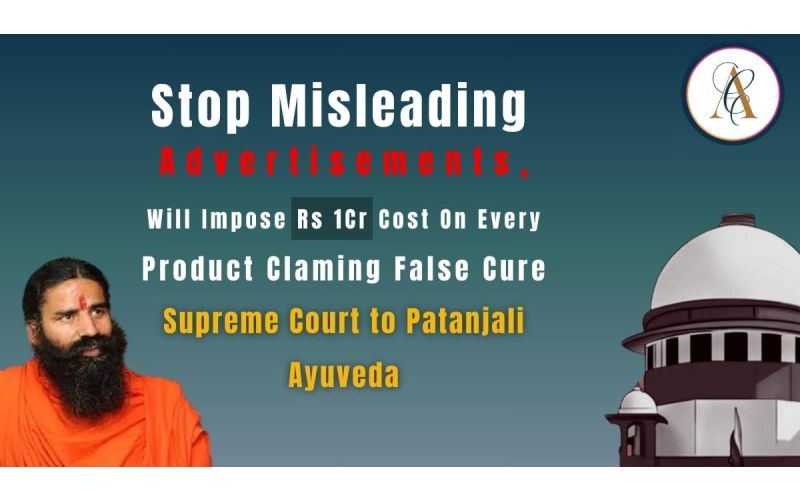
Stop Misleading Advertisements, Will Impose Rs 1 Crore Cost On Every Product Claiming False Cure: Supreme Court To Patanjali Ayurved
The Supreme Court on Tuesday (November 21) reprimanded the Patanjali Ayurved for continuing to publish misleading claims and advertisements against modern systems of medicine. While considering a petition filed by the Indian Medical Association against misleading advertisements, the bench comprising ...

Evolving Social and Constitutional Rights for LGBTQ+ Communities
The journey toward equality for LGBTQ+ communities in India has been marked by significant legal and social milestones. From the decriminalization of same-sex relationships to ongoing debates about marriage equality and adoption rights, the evolution of LGBTQ+ rights reflects the ...
Children Born Out Of Irregular Marriage Legitimate Muslim Law – Supreme Court
The Rajya Sabha has passed the JThe Supreme Court has noted that children born out of irregular marriages, including one between a Muslim man and a Hindu woman, are legitimate and therefore eligible to inherit intestate property as per applicable ...

Speak With Our
Get a Appointment