
Evolving Social and Constitutional Rights for LGBTQ+ Communi
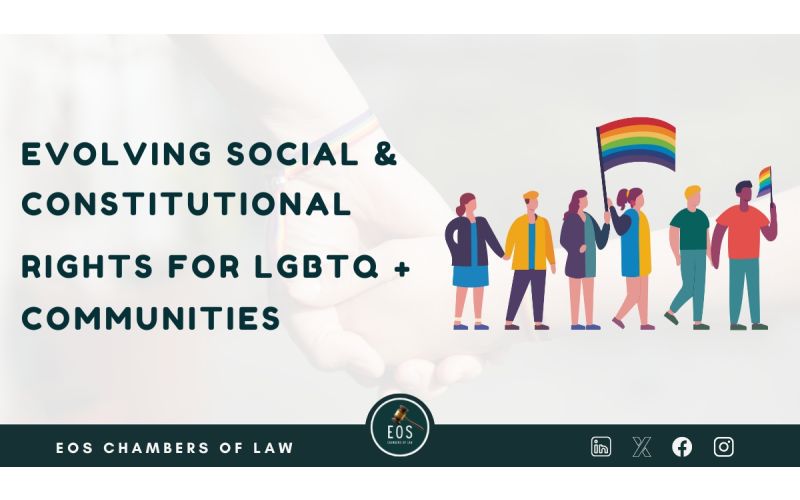
Evolving Social and Constitutional Rights for LGBTQ+ Communities
|
The journey toward equality for LGBTQ+ communities in India has been marked by significant legal and social milestones. From the decriminalization of same-sex relationships to ongoing debates about marriage equality and adoption rights, the evolution of LGBTQ+ rights reflects the interplay between constitutional principles and societal progress.
Key Milestones in LGBTQ+ Rights:
- Decriminalization of Homosexuality (Navtej Johar v. Union of India, 2018):
The landmark Supreme Court judgment struck down Section 377 of the Indian Penal Code, decriminalizing consensual same-sex relationships. The court emphasized that the right to privacy and equality applies to all individuals, irrespective of their sexual orientation. - Recognition of Transgender Rights (NALSAR Case, 2014):
The Supreme Court’s ruling in National Legal Services Authority v. Union of India recognized transgender individuals as a third gender, affirming their right to self-identify and access affirmative actions such as education and employment quotas. - Anti-Discrimination Protections:
While India lacks comprehensive anti-discrimination laws for LGBTQ+ individuals, the courts have increasingly upheld their rights. Several state and local governments have issued guidelines to ensure inclusivity in workplaces and schools.
Constitutional Foundations of LGBTQ+ Rights:
- Equality and Non-Discrimination:
Article 14 (equality before the law) and Article 15 (prohibition of discrimination) form the bedrock of constitutional protections for LGBTQ+ individuals. - Right to Privacy:
Article 21 guarantees the right to life and personal liberty, interpreted to include privacy and dignity. The Puttaswamy v. Union of India judgment strengthened this principle, laying the foundation for further rights. - Freedom of Expression:
Article 19 protects the right of LGBTQ+ individuals to express their identities without fear of persecution.
Challenges and the Road Ahead:
Despite progress, several challenges persist:
- Marriage Equality:
Same-sex marriages are not yet legally recognized, limiting LGBTQ+ couples' access to marital rights like inheritance, taxation benefits, and spousal healthcare. - Adoption and Parenthood:
The legal framework does not fully recognize adoption by LGBTQ+ couples, creating barriers to family formation. - Social Acceptance:
Stigma and discrimination remain prevalent, particularly in rural areas, hindering the full realization of constitutional rights. - Workplace Inclusivity:
While corporate India has made strides in creating LGBTQ+ inclusive workspaces, a comprehensive anti-discrimination law is needed to ensure uniformity across sectors.
Global Inspiration:
Countries like Canada, South Africa, and the Netherlands provide robust legal frameworks for LGBTQ+ rights, including marriage equality and anti-discrimination laws. Their models can serve as benchmarks for India’s progress.
Conclusion:
The constitutional promise of equality and dignity must extend to all individuals, including LGBTQ+ communities. Legal advancements alone cannot achieve this; societal attitudes must evolve in tandem. Continued advocacy, judicial interventions, and public discourse are essential to bridge the gap between legal recognition and social acceptance.
As India progresses, embracing inclusivity and diversity will strengthen its democracy and reaffirm its commitment to human rights.
Post Categories
Featured Posts





Latest Posts








Latest Posts

Elevate Your Legal Strategy with Expert Witness Preparation Support
Introduction: In the realm of legal proceedings, witness testimony can make or break a case. It's the narrative that often tips the scales of justice. Yet, preparing witnesses for the courtroom is a nuanced art—one that demands expertise, strategy, and ...
Private Class 12 Student Eligible To Take NEET, Says NMC; Supreme Court Allows MBBS Admission
The Supreme Court recently allowed a candidate who passed Class 12 as a private student to take admission for MBBS course after NEET counselling. This was after the National Medical Commission informed the Court that as per the latest Graduate ...
Motor Accident Claims – Social Status Of Deceased To Be Considered If There’s No Definite Proof Of Income: Supreme Court
The Supreme Court has reinstated an award originally granted by the Motor Accidents Claim Tribunal (MACT). The apex court expressed disappointment over the approach taken by the High Court in evaluating the evidence and reinstated the MACT’s verdict. The Court ...

An Exegesis On Criminal Offences: A Legal Discourse From The Pinnacle Of The Indian Judiciary
Index: Introduction Understanding Criminal Offences 2.1 Petty Offences 2.2 Cognizable Offences 2.3 Non-Cognizable Offences Consequences of Criminal Offences 3.1 Legal Consequences 3.2 Social and Personal Impact 3.3 Societal Costs Conclusion———————————— Introduction: Criminal offenses encapsulate acts that transgress established laws and regulations, warranting punitive measures imposed ...
Inheritance and Succession Laws: What Every NRI Should Know
For Non-Resident Indians (NRIs), navigating inheritance and succession laws in India can be complex. Whether dealing with ancestral property, inheriting assets, or managing family estates, NRIs must understand the legal framework to safeguard their rights and avoid disputes. Here are ...

ADR in Workplace Conflicts: A Guide for Employers and Employees
Workplace conflicts are inevitable. Whether stemming from miscommunication, differences in expectations, or interpersonal issues, they can disrupt the professional environment and affect productivity. For both employers and employees, finding a way to resolve these conflicts quickly, fairly, and cost-effectively is ...

Speak With Our
Get a Appointment