
Transgender Persons Can Avail Of Already Earmarked Reservati
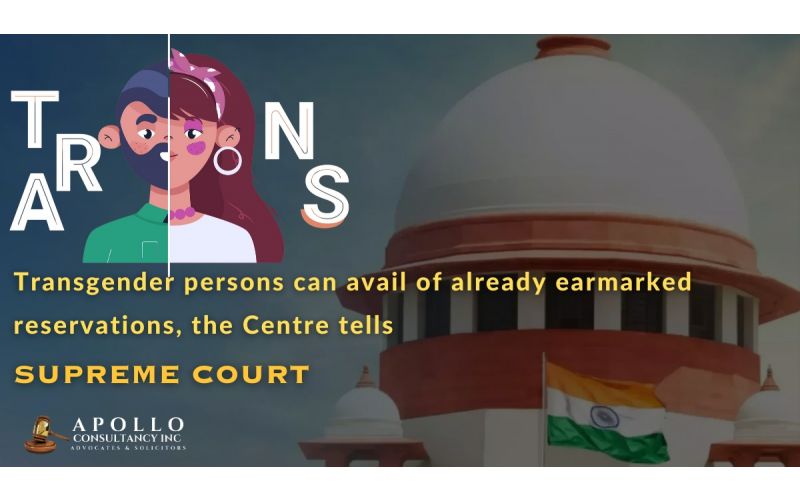
Transgender Persons Can Avail Of Already Earmarked Reservations, The Centre Tells : Supreme Court
|
The Centre has informed the Supreme Court that transgender persons can avail the already earmarked reservations in jobs and educational admissions and there is no separate reservation being provided to them. In 2014, the top court directed the Centre and the state governments to treat transgenders as “socially and educationally backward classes” and extend all kinds of reservation to them in cases of admission in educational institutions and for public appointments. The historical verdict recognised the “third gender” and granted legal recognition to their gender identity.
The Centre has informed the Supreme Court that the transgender persons can avail the already earmarked reservations in jobs and educational admissions and there is no separate reservation being provided to them.
In 2014, the top court directed the Centre and the state governments to treat transgenders as “socially and educationally backward classes” and extend all kinds of reservation to them in cases of admission in educational institutions and for public appointments. The historical verdict recognised the “third gender” and granted legal recognition to their gender identity.
In March this year, the Supreme Court had issued a contempt notice on a petition alleging non-compliance of its order rendered in the landmark case of National Legal Services Authority versus Union of India.
“The benefits of reservation in matters of direct recruitment in Central Government Services and in admission to Central Government Higher Educational Institutions are as follows- Scheduled Castes (SC)- 15%; Scheduled Tribes (ST) – 7.5%; Socially and Educationally Backward Classes (SEBC) – 27%; Economically Weaker Sections (EWS)- 10%. In this regard, it is respectfully submitted that the benefits of any of the reservations including the above four reservations can be availed by the marginalised and eligible population of the country including transgender persons,” said the Centre in its reply.
The affidavit filed by the Secretary in the Union Ministry of Social Justice and Empowerment said that the “transgender belonging to SC/ST/SEBC communities are already entitled to reservations earmarked for these communities.”
Further, it added that any transgender outside the SC/ST/SEBC communities with family income Rs 8 lakh is automatically covered in the EWS category.
The affidavit highlighted the several other steps taken by the Union Government to ameliorate the problems of the transgender community.
It said that a national portal for transgender persons has been launched by the ministry for obtaining transgender certificate of Identity.
Also, a National Council for Transgender Persons has been constituted on August 21, 2020 to advise the government on policies, programmes, legislation and projects with respect to transgender persons.
It stated that recommendations made by an Expert Committee constituted by the ministry were duly incorporated in the Transgender Persons (Protection of Rights) Act, 2019 and the Transgender Persons (Protection of Rights) Rules, 2020.
Post Categories
Featured Posts







Latest Posts








Latest Posts
Adultery No Longer A Criminal Offence In India, Rules Supreme Court
The Rajya Sabha has passed the Jammu and Kashmir The court underlined that Section 497 treats women as properties of their husbands and is hence manifestly discriminatory. It trashed the central government’s defense of Section 497 that it protects sanctity ...

Evolving Social and Constitutional Rights for LGBTQ+ Communities
The journey toward equality for LGBTQ+ communities in India has been marked by significant legal and social milestones. From the decriminalization of same-sex relationships to ongoing debates about marriage equality and adoption rights, the evolution of LGBTQ+ rights reflects the ...

Indian Penal Code
The Indian Penal Code (IPC) is the official criminal code of India. It is a comprehensive code intended to cover all substantive aspects of criminal law. The code was drafted on the recommendations of the first law commission of India ...

Legal Challenges in NRI Marriages
Introduction Non-Resident Indian (NRI) marriages, while often joyous, can also bring a unique set of legal challenges. These challenges stem from cross-border legal systems, differing cultural expectations, and complex family dynamics. Understanding these issues is crucial for NRIs and their ...

🏠 𝐋𝐞𝐠𝐚𝐥 𝐂𝐡𝐞𝐜𝐤𝐥𝐢𝐬𝐭 𝐁𝐞𝐟𝐨𝐫𝐞 𝐈𝐧𝐯𝐞𝐬𝐭𝐢𝐧𝐠 𝐢𝐧 𝐈𝐧𝐝𝐢𝐚𝐧 𝐑𝐞𝐚𝐥 𝐄𝐬𝐭𝐚𝐭𝐞 (2025 𝐄𝐝𝐢𝐭𝐢𝐨𝐧)
𝐍𝐑𝐈 𝐨𝐫 𝐇𝐍𝐈? 𝐃𝐨𝐧’𝐭 𝐈𝐧𝐯𝐞𝐬𝐭 𝐖𝐢𝐭𝐡𝐨𝐮𝐭 𝐓𝐡𝐞𝐬𝐞 7 𝐋𝐞𝐠𝐚𝐥 𝐂𝐡𝐞𝐜𝐤𝐬! Real estate remains one of the most trusted investment avenues for 𝐍𝐑𝐈𝐬 𝐚𝐧𝐝 𝐇𝐍𝐈𝐬 𝐢𝐧 𝐈𝐧𝐝𝐢𝐚. But with rising frauds, title disputes, and compliance issues—a beautiful property can become a ...

Navigating Cyber Crime Laws in India: A Legal Perspective
The rapid proliferation of digital technologies has transformed India’s social, economic, and professional landscape. While digitalization brings efficiency and innovation, it also exposes individuals and businesses to cybercrime risks. As a lawyer in India, it is crucial to understand the ...

Speak With Our
Get a Appointment