
75% Eligibility Condition For Admission To Sports Quota ‘U

75% Eligibility Condition For Admission To Sports Quota ‘Unwarranted & Discriminatory
|
The Supreme Court has held that the eligibility condition of minimum 75% marks does not promote the object of introducing the sports quota, and such criterion subverts the object and falls afoul of the equality clause in Article 14 of the Constitution.
A bench of Justices S Ravindra Bhat and Aravind Kumar made the ruling as they recently considered a special leave petition filed against the order of the Punjab and Haryana High Court rejecting the petition which had questioned the imposition of a minimum 75 per cent aggregate marks as an eligibility condition (in the qualifying examination) for enabling a candidate to claim admission in engineering courses under the 2 per cent sports quota.
The appellant who did not secure the basic 75 per cent marks, had approached the High Court complaining that the eligibility condition was unrealistically high after one seat had fallen vacant in the Materials and Metallurgical Engineering branch in the PEC University of Technology.
The eligibility criterion for admission to engineering courses under sports quota mentioned that the candidate should have secured a minimum of 75 per cent marks in the Class 12 examination of the respective stream and Board.
Before the apex court, senior advocate P.S. Patwalia, appearing for the appellant, contended that the minimum eligibility condition of having acquired 75 per cent marks, defeats the objective of providing a sports quota because it assumes that sports persons – like other general candidates – would also have the same degree of academic excellence which is required of all other candidates.
In its judgment, the Supreme Court held that the exclusion of the petitioner and other like candidates, on the ground of their securing less than 75 per cent in the qualifying examination, was unwarranted and discriminatory.
It directed that the remaining seat(s) will be filled by the University in accordance with the sports policy of the UT of Chandigarh, after determining inter se sports merit of the candidates who had applied, but whose candidature was rejected on the ground of ineligibility due to their securing less than 75 per cent marks.
These candidates, however, should have qualified in terms of the immediately preceding academic year’s criterion, applicable for the balance sports quota seat(s), the top court clarified. It added that candidates who have been selected and given admission will not be disturbed.
Post Categories
Featured Posts







Latest Posts








Latest Posts

No Law Gives Right To Husband To Beat & Torture His Wife: Delhi High Court Grants Divorce To Woman On Ground Of Cruelty And Desertion
Synopsis The court was hearing an appeal by a woman challenging the decision of the trial court, whereby it has dismissed her petition seeking divorce from the man on the ground of cruelty and desertion While granting divorce to a woman ...

Legal Challenges in NRI Marriages
Introduction Non-Resident Indian (NRI) marriages, while often joyous, can also bring a unique set of legal challenges. These challenges stem from cross-border legal systems, differing cultural expectations, and complex family dynamics. Understanding these issues is crucial for NRIs and their ...
UPSC CSE: No Interim Relief, Delhi High Court Asks CAT To Expeditiously Decide On Plea To Lower CSAT Cut-Off
The Delhi High Court on Wednesday asked the Central Administrative Tribunal to decide expeditiously the Plea seeking reduction in the cut off from 33% to 23% for qualifying Part II (CSAT) exam of 2023 Civil Services Examination conducted by UPSC ...
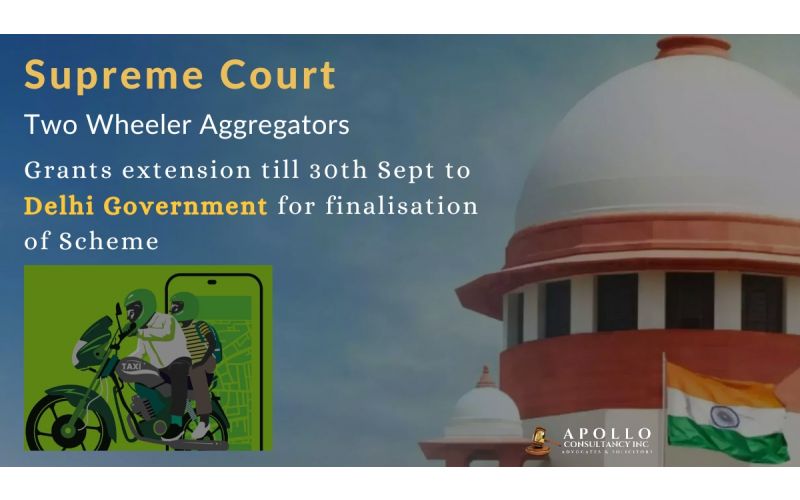
Supreme Court Grants Extension Till September 30 To Delhi Government For Finalisation Of Scheme : Two Wheeler Aggregators
The Supreme Court on Monday directed the Delhi government to finalise the Delhi Motor Vehicle Aggregator and Delivery Service Provider Scheme, 2023 for regulation of two wheeler aggregators by September 30. The Division Bench of Justice Aniruddha Bose and Justice ...

Buyer Not Complying With Timeline For Payment Can't Seek Specific Performance Of Agreement To Sell : Supreme Court
The Supreme Court in a recent decision held that when a contract stipulates a specific time frame within which the consideration needs to be paid by the 'buyer' to execute the 'agreement to sale' by the 'seller', then the buyer ...

International Arbitration: Navigating Cross-Border Disputes with ADR
As global business transactions increase, so do the risks of cross-border disputes. When parties from different countries find themselves in conflict, traditional litigation can be slow, costly, and fraught with jurisdictional complexities. This is where Alternative Dispute Resolution (ADR)—specifically, international ...

Speak With Our
Get a Appointment