
Maternity Benefits Must Be Granted Even If Period Of Benefit
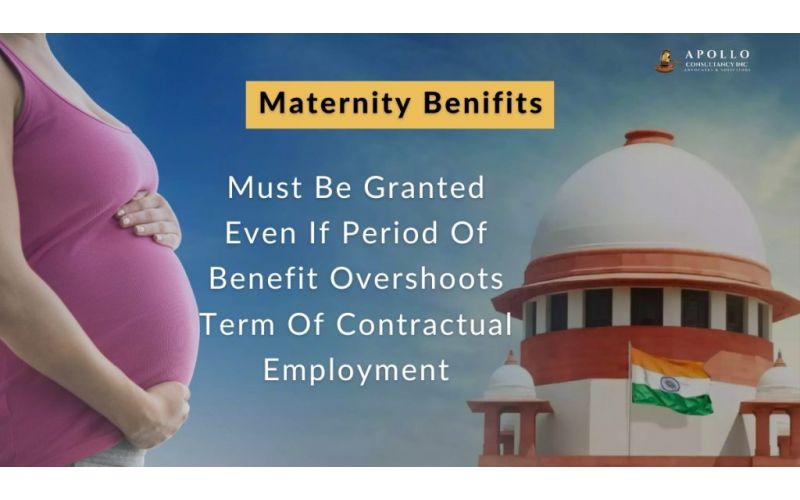
Maternity Benefits Must Be Granted Even If Period Of Benefit Overshoots Term Of Contractual Employment: Supreme Court
|
The Supreme Court on Thursday(17 Aug) held that maternity benefits have to be granted even if the period of benefit overshoots the term of contractual employment. Maternity benefits can travel beyond the term of contractual employment. The court directed the employer to pay maternity benefits as would have been available in terms of Sections 5 and 8 of the Maternity Benefits Act, 1961 and payment to be made within 3 months.
The court underlined that the statute itself envisions the continuation of benefits beyond the term of employment, asserting that entitlement to medical benefits, as stipulated under Section 5, Maternity Benefits Act, 1961 goes beyond the confines of employment duration.
The court observed “Section 12(2(a)) of the Maternity Benefit Act, 1961 contemplates entitlement even for an employee who is dismissed/discharged during her pregnancy. Thus, inbuilt in the statute itself there is a provision for extending benefits for a period beyond the term of employment. What the statute contemplates is the entitlement of medical benefit which accrues by fulfilment of condition under section 5 and benefit can travel beyond the term of employment also and it’s not co-terminus with the employment period.”
The court also referred to previous judgments which had upheld the principle of extending maternity benefits and noted that section 27 of the Act overrides other laws and agreements.
The court observed that in MCD v Female workers, a 2 judge bench granted maternity benefits. The same view is reflected in the case of the Court observed.
A 3-judge bench comprising Justices Aniruddha Bose, Justice Sanjay Kumar and Justice SVN Bhatti was hearing an appeal against a Delhi High Court ruling that had restricted maternity benefits to a mere 11-day period, citing the expiration of a contractual agreement.
At the outset. Advocate Mr. Sourav Gupta appearing on behalf of the appellant argued that once the appellant fulfills the prerequisite under section 5(2) of the Act, a contractual employee would be entitled to full benefits as contemplated therein. He also submitted that the appellant also fulfils the requirement of having worked more than 180 days during the preceding 1 year.
He invoked Section 5(3), which prescribes a maximum period of 26 weeks for maternity leave. Emphasizing the broad scope of the Act, he argued that it extends its protection even to new born children, underscoring the legislative intent to provide support even beyond the employment period.
He referred to section 27 of the Act and strongly posited that this provision overrides agreements, and the rights accrued under the statute must be upheld even if the employment contract expires.
The question of an opt-out clause was raised by the Bench, prompting the appellant to clarify that employers have the prerogative to grant additional benefits, but existing rights must be preserved.
The court sought to understand the scheme of the Maternity Benefit Act, specifically, the remedy available to a woman denied her rightful benefits. The bench referred to Section 17 which revealed the role of an inspector but added that “surprisingly it doesn’t mention who is prescribed authority.”
The appellant responded that usually writ petitions are filed before High Courts. In this case, they had gone to CAT and then Delhi HC.
Moving forward, the appellant then referred to Parliamentary discussions to fortify their position
Justice Bose intervened and said, “We’re already with you on the import and inspiration behind the Act.”
Then, the appellant referred to MCD Delhi v. Female Workers case, which extended maternity benefits to daily wage laborers. He contended that “In this Act, only a pre-requisite for claiming maternity benefits is given.
The main issue for determination before the court was whether maternity benefits would apply to contractual employees if the period of benefit overshoots the contractual period?
Advocate Rachita Garg sought on behalf of the respondent argued that once the term of the contract ends, there cannot be a notional extension of same by giving her the benefit of the 1961 Act. Any benefit she would be entitled to ought to be within a contractual period and the same cannot extend beyond that period.
At this juncture, Justice Sanjay Kumar asked her “There’s no discussion on s. 12(2(a) at all? How do you get over that provision? Discharge is a wide term, even dismissal will not disentitle to get all benefits even after termination of employment. Here, only her term has expired and she stands on a much better footing.”
The respondent replied, “if we grant benefits then they’ll come to us saying that the contract has been extended”.
The Bench remarked that “he’s not even asking for that. In this case, there’s no way you can get over the statutory scheme”.
BACKGROUND OF THE CASE
The appellant had joined as a pathology doctor on a contractual basis at Janak puri Hospital run by NCT, Delhi. Her contract was subject to renewal every year for up to max 3 yrs.
On 24th May, she applied for maternity leave from 1st June 2017 in terms of section 5 of Act,1961. The employer however provided benefits only up to 11th June on the ground that after the end of 3 yr contractual period, she became disentitled to any benefit under said statute.
The appellant unsuccessfully challenged said action before CAT and Delhi High Court.
Post Categories
Featured Posts







Latest Posts








Latest Posts

Members Of Railway Protection Force Can Seek Benefit Under Employees Compensation Act Though RPF Declared As An Armed Force: Supreme Court
The Supreme Court on Monday (26.09.2023), held that an officer of the Railway Protection Force (RPF) can seek compensation under Employees Compensation Act, 1923 even though the RPF has been declared to be an armed force of the Union. “..in ...

Transfer Of Property Act | Rents Receivable Can Be Assigned By Debtor To Creditor As Actionable Claim: Supreme Court
Rents receivable by a borrower can be assigned to a lender as an "actionable claim" as per the Transfer of Property Act,1882(TPA), held the Supreme Court while deciding a dispute between the Infrastructure Leasing and Financial Services Ltd and the ...
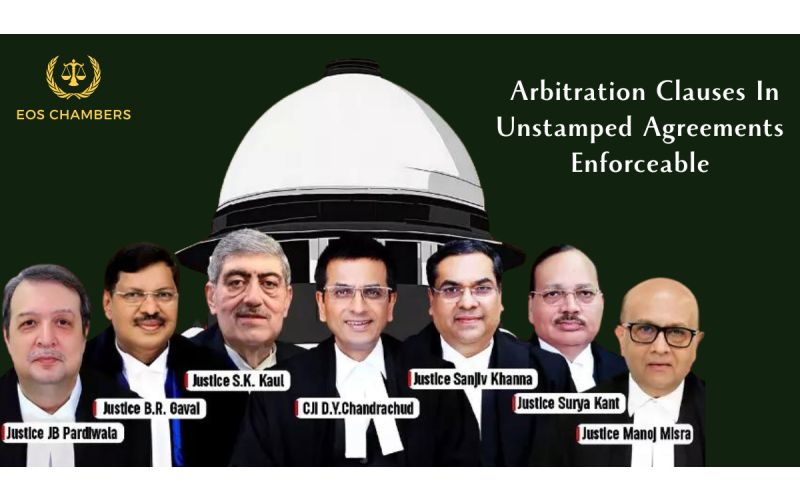
BREAKING | Arbitration Clauses In Unstamped Agreements Enforceable : Supreme Court 7-Judge Bench Overrules 'NN Global' Decision
A seven-judge bench of the Supreme Court on Wednesday (December 13) ruled that arbitration clauses in unstamped or inadequately stamped agreements are enforceable. Insufficiency of stamping does not make the agreement void or unenforceable but makes it inadmissible in evidence. ...

New Training Programme For New Lawyers. By Chief Justice Of India DY CHANDRACHUD 🇮🇳
‘Judges can’t burden lawyers due to uneasiness with technology’: CJI Chandrachud- CJI Chandrachud appealed to judges to continue hybrid hearings, saying that this was not just meant for the Covid-19 pandemic period. Chief Justice of India (CJI) DY Chandrachud on ...

𝐔𝐩𝐡𝐨𝐥𝐝𝐢𝐧𝐠 𝐄𝐭𝐡𝐢𝐜𝐬 𝐚𝐧𝐝 𝐏𝐫𝐨𝐟𝐞𝐬𝐬𝐢𝐨𝐧𝐚𝐥 𝐑𝐞𝐬𝐩𝐨𝐧𝐬𝐢𝐛𝐢𝐥𝐢𝐭𝐲 𝐢𝐧 𝐓𝐨𝐝𝐚𝐲’𝐬 𝐋𝐞𝐠𝐚𝐥 𝐋𝐚𝐧𝐝𝐬𝐜𝐚𝐩𝐞!
In the realm of law, ethics and professional responsibility form the bedrock upon which trust, integrity, and justice stand. As guardians of the legal system, it is incumbent upon legal professionals to adhere to the highest ethical standards, ensuring fairness, ...
SC Ruling On User Development Fee Provides Guidance For GST, Tax On Royalty
The SC had held that UDF collected by the DIAL is in the nature of statutory levy and the same would not be taken as consideration against any services.A recent judgment by the Supreme Court (SC) on the user development fee (UDF) collected by the Delhi International Airport Limited (DIAL) ...

Speak With Our
Get a Appointment