
Motor Accident Claims – Social Status Of Deceased To Be Co
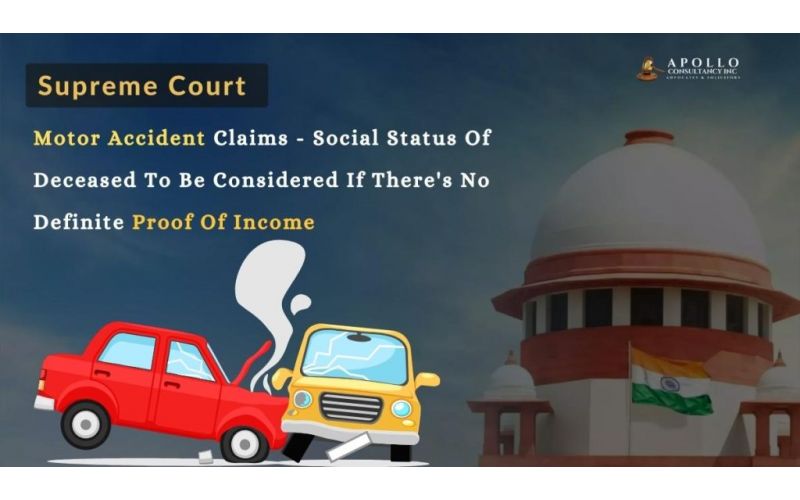
Motor Accident Claims – Social Status Of Deceased To Be Considered If There’s No Definite Proof Of Income: Supreme Court
|
The Supreme Court has reinstated an award originally granted by the Motor Accidents Claim Tribunal (MACT). The apex court expressed disappointment over the approach taken by the High Court in evaluating the evidence and reinstated the MACT’s verdict.
The Court observed “It is unfortunate that in a case of the present nature, the High Court while assessing the evidence available on record, has sought to seek strict evidence with regard to the income of the deceased. In a matter of the present nature where compensation is sought and even in the absence of definite proof of the income, the social status of the deceased is to be kept in perspective where such persons are employed in unorganized sector and the notional income, in any event, is required to be taken into consideration. More so in a circumstance, where the MACT had referred to the evidence available on record and then arrived at its conclusion, the re-appreciation of evidence by the High Court is without being sensitive to nature of lis before it.”
The Supreme Court bench comprising Justices A.S. Bopanna and Justice Prashant Kumar Mishra was hearing an appeal against HC judgment which had reduced the amount of compensation from Rs 11,87,000 to 4,75,000 to claimants in a motor accident case.
The case pertained to the untimely demise of an individual who was the sole earning member of his family. The High Court’s approach to evaluating the evidence regarding the deceased’s income had raised concerns, as the claimants were unable to secure comprehensive documentation due to the deceased’s employment status in the unorganized sector.
Despite this challenge, the MACT had made efforts to assess the deceased’s income and concluded that he was working as a skilled mechanic in a two-wheeler repair shop.
In its judgment, the Supreme Court highlighted that when dealing with cases involving individuals employed in the unorganized sector, it is crucial to consider the notional income based on their social status. The Court emphasized that even in the absence of concrete proof of income, the notional income should be taken into account, especially when the claimants are dependents of the deceased.
The Supreme Court criticized the High Court’s strict approach in seeking exhaustive evidence of the deceased’s income and ownership of the repair shop where he worked.
The Court emphasized that the nature of cases involving the unorganized sector requires sensitivity and consideration of the deceased’s social circumstances.
Consequently, the Supreme Court set aside the judgment issued by the High Court on March 5, 2019, and restored the Award originally granted by the MACT on March 13, 2007. The Court directed the Insurance Company to deposit the awarded amount within four weeks from the date of receipt of the judgment.
Post Categories
Featured Posts


Latest Posts








Latest Posts
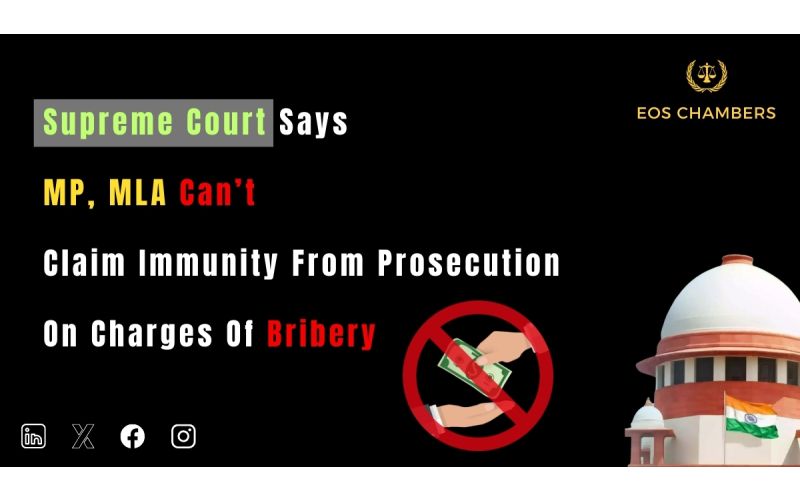
Supreme Court Says MP, MLA Can’t Claim Immunity From Prosecution On Charges Of Bribery
The seven-judge Constitution bench of the Supreme Court said it disagreed with the judgment in PV Narasimha and the judgment in PV Narasimha which grants immunity to legislators for allegedly bribery for casting a vote or speech has “wide ramifications ...
Grant Of Bail Can't Be Made Dependent On Surrender Of Co-Accused : Supreme Court
A Division Bench of the Supreme Court, while allowing a bail plea, held that the grant of bail to a co-accused person cannot be contingent on the surrender of another accused who is also pertinently the main accused in the ...
Startups and Legal Compliance: A Guide to Navigating Indian Laws🏛️
Starting a business in India is an exciting journey filled with opportunities and challenges. One critical aspect that often poses a challenge for startups is navigating the complex landscape of legal compliance. Understanding and adhering to the various laws and ...
New Training Programme For New Lawyers. By Chief Justice Of India DY CHANDRACHUD 🇮🇳
‘Judges can’t burden lawyers due to uneasiness with technology’: CJI Chandrachud- CJI Chandrachud appealed to judges to continue hybrid hearings, saying that this was not just meant for the Covid-19 pandemic period. Chief Justice of India (CJI) DY Chandrachud on ...

Legal Challenges in Cryptocurrency and Blockchain: Exploring the Evolving Legal Landscape
The rise of cryptocurrencies and blockchain technology has revolutionized the financial world, but it has also brought about a series of complex legal challenges. As more businesses and individuals adopt digital currencies and decentralized systems, governments and regulatory bodies are ...
Empowering NRIs: Facilitating Political Participation Through Voting Rights!
Introduction: In the digital age of globalization, the world is more interconnected than ever before. Non-Resident Indians (NRIs) are an integral part of this global community, contributing to economies, cultures, and societies around the world. However, despite their significant impact, ...

Speak With Our
Get a Appointment