
Supreme Court Dismisses PIL Seeking Independent Audit Of EVM
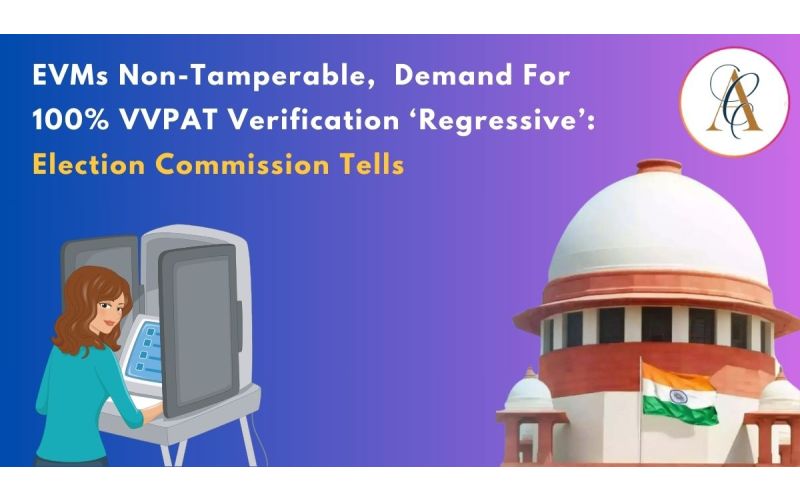
Supreme Court Dismisses PIL Seeking Independent Audit Of EVM Source Codes
|
The Supreme Court on Friday refused to entertain a Public Interest Litigation (PIL) seeking an independent audit of source codes of Electronic Voting Machines (EVMs). The bench comprising CJI DY Chandrachud, Justice JB Pardiwala, and Justice Manoj Misra noted that the matter concerned sensitive policy issues and thus, the court was not inclined to interfere with the same.
At the outset, the petitioner Sunil Ahya, appearing as party-in- person, asserted before the court that the 'source code' was like the brain of the EVMs and thus was required to be audited. He stated that there existed no formal audit report of the source code in any public domain and even when he filed an RTI application seeking for the same, the Election Commission of India (ECI) could not provide him with the same. In fact, he stated that he made three representations to the ECI but to no avail.
Referring to such auditing as necessary for the "survival of democracy", Ahya urged the bench to consider his petition.However, the bench expressed its disinclination towards entertaining the PIL stating that there already existed requisite security audits for protection in such cases. The CJI said–
"Every time we put out even a new application in the Supreme Court, we have to go through a security audit...Nothing can happen. Rest assured, there are standard guidelines..."
However, the petitioner questioned–
"What standard guidelines? They're not in public domain."
At this juncture, the CJI underlined that such things could not be provided in the public domain as they could be misused by unscrupulous elements. He said–
"If I start putting out source code of e-filing in public, who knows who'll be able to hack it."
While the petitioner reiterated his submission and said, "we are voting in an EVM where the brain of the EVM system is not being audited", the court ultimately refused to entertain the PIL. The court noted that the matter bore on sensitive issues and on such a policy issues, the court was not inclined to issue a direction which has been sought. The bench added–
Petitioner places no actionable material before this court to show that ECI has acted in breach of its constitutional mandate...No material has been placed to show that ECI is not fulfilling its mandate.
Post Categories
Featured Posts





Latest Posts








Latest Posts
Supreme Court Dismisses PIL Seeking Independent Audit Of EVM Source Codes
The Supreme Court on Friday refused to entertain a Public Interest Litigation (PIL) seeking an independent audit of source codes of Electronic Voting Machines (EVMs). The bench comprising CJI DY Chandrachud, Justice JB Pardiwala, and Justice Manoj Misra noted that ...
ED Summons Under PMLA: What to Do and What Not to Do (Complete Legal Guide)
Receiving a summons from the Enforcement Directorate (ED) under the Prevention of Money Laundering Act, 2002 (PMLA) can be intimidating. For many individuals—business owners, directors, promoters, professionals, or even family members—an ED summons creates panic, confusion, and fear of arrest. ...
Government trying to draft laws in simple manner and in Indian languages: Pm Modi
Prime Minister Narendra Modi emphasized the importance of lawyers and the judiciary in shaping the country's legal system. Prime Minister Narendra Modi expressed his gratitude to the legal fraternity for their substantial contribution to the country's independence movement and its ...
Arbitration Law Needs To Tackle A Key Concern
The arbitration law has undergone repeated amendments with only one aim — making India the hub of international arbitration. Last month, the government set up an expert panel headed by former law secretary TK Viswanathan to suggest reforms in the ...
EVMs Non-Tamperable, Demand For 100% VVPAT Verification Regressive: Election Commission Tells Supreme Court
Ahead of the 2024 Lok Sabha elections, the Election Commission of India (ECI) has staunchly defended electronic voting machines (EVM) as ‘non-tamperable’, both owing to technological measures and strict administrative and security procedures designed by the commission. In a recent ...
Cheque Bounce Case Can Be Quashed U/S 482 Only If Amount Is Patently Non-Recoverable; Whether Debt Time-Barred Or Not Is A Question Of Evidence : SC
The Supreme Court observed that the question whether a cheque was issued towards a time barred debt is to be decided on evidence. “It is only in cases wherein an amount which is out and out non-recoverable, towards which a ...

Speak With Our
Get a Appointment