
Companies Act – Decision To Allot Additional Shares Cannot
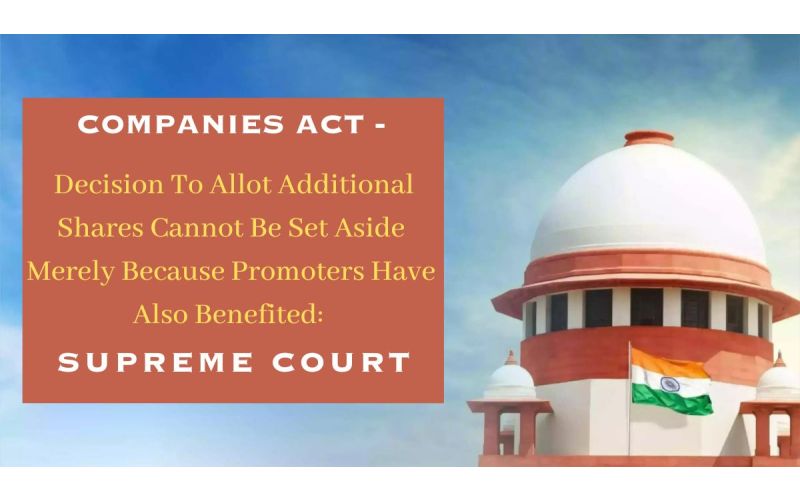
Companies Act – Decision To Allot Additional Shares Cannot Be Set Aside Merely Because Promoters Have Also Benefited: Supreme Court
|
The Supreme Court has upheld the largely disproportionate allotment of rights share in favour of one group of shareholders of a private limited company, substantially increasing its shareholding percentage in the company over other group of shareholders.
The bench comprising
Justices K.M. Joseph and B.V. Nagarathna
found that the increase in the appellant- H.M. Patel Group’s shareholding from 30.80% to 63.58% of the paid-up share capital of the private company, was the result of the other shareholder-group’s refusal to apply for the additional shares, despite being given the opportunity. Thus, the allotment of fresh shares could not be characterized as oppressive, the court ruled.
The court held that after the Board of Directors had resolved to allot additional shares to the existing shareholders in the ratio of 1:1, while also giving them the option to apply for more or lesser number of shares than they were entitled to, the members of the H.M. Patel Group had applied for a greater number of shares. The shareholders constituting the other shareholders’ group, however, did not apply for the same.
The court thus ruled that there was no defect in the allotment of additional shares after the authorized share capital of the company was increased by a resolution passed in the Extraordinary General Meeting of the shareholders. The top court thus set aside the order of the National Company Law Appellate Tribunal (NCLAT) where it had ruled that the distribution of the additional shares was ‘defective’. The Tribunal had directed the allotment of additional shares to all the existing shareholders of the company in proportion to their shareholding.
The Apex Court noted that the members of the H.M. Patel Group were members of the Board of Directors at the time the decision to increase the authorized share capital and issue fresh shares was taken. It held that though Section 81(3) of Companies Act, 1956 expressly exempts a private limited company from the purview of Section 81, which deals with further issue of capital; however, notwithstanding the same, the conduct of the Directors is to be judged on a higher yardstick.
The court, however, remarked that the fact that the Directors may also benefit from a decision taken primarily with the intention to promote the interest of the Company, cannot vitiate the decision. Thus, even though the Directors who constituted the said shareholders’ group, benefited and made a gain from the implementation of a decision taken primarily with a view to safeguard the interest of the Company, it cannot by itself render the decision vulnerable to attack.
Source
Post Categories
Featured Posts







Latest Posts








Latest Posts

Government trying to draft laws in simple manner and in Indian languages: Pm Modi
Prime Minister Narendra Modi emphasized the importance of lawyers and the judiciary in shaping the country's legal system. Prime Minister Narendra Modi expressed his gratitude to the legal fraternity for their substantial contribution to the country's independence movement and its ...
UPSC CSE: No Interim Relief, Delhi High Court Asks CAT To Expeditiously Decide On Plea To Lower CSAT Cut-Off
The Delhi High Court on Wednesday asked the Central Administrative Tribunal to decide expeditiously the Plea seeking reduction in the cut off from 33% to 23% for qualifying Part II (CSAT) exam of 2023 Civil Services Examination conducted by UPSC ...
Understanding Indian Constitutional Laws: A Brief Overview
Introduction: Indian Constitutional Law is the backbone of the country's legal system, laying down the framework for governance, rights, and duties of citizens, and the functioning of various institutions. Enshrined in the Constitution of India, adopted on January 26, 1950, ...
NEET-PG : Supreme Court Dismisses Plea Challenging Reduction Of NEET-PG 2023 Qualifying Percentile To Zero
The Supreme Court on Monday (September 25) dismissed a petition challenging the decision of the Union Government to reduce the cut-off for post-graduate medical college admissions through NEET-PG 2023 exam as zero percentile. A bench comprising dismissed a PIL filed ...

Repatriation of Funds and Investments: Legal Guidelines for NRIs
For Non-Resident Indians (NRIs), repatriating funds and investments back to their country of residence is a crucial aspect of financial management. However, navigating the legal landscape can be complex. Here are essential guidelines NRIs should follow to ensure smooth and ...

AI and Big Data in Legal Case Management
The integration of artificial intelligence (AI) and big data into legal case management is revolutionizing the way law firms and legal professionals operate. These technologies offer unprecedented opportunities to streamline processes, enhance decision-making, and improve client outcomes. The Role of ...

Speak With Our
Get a Appointment